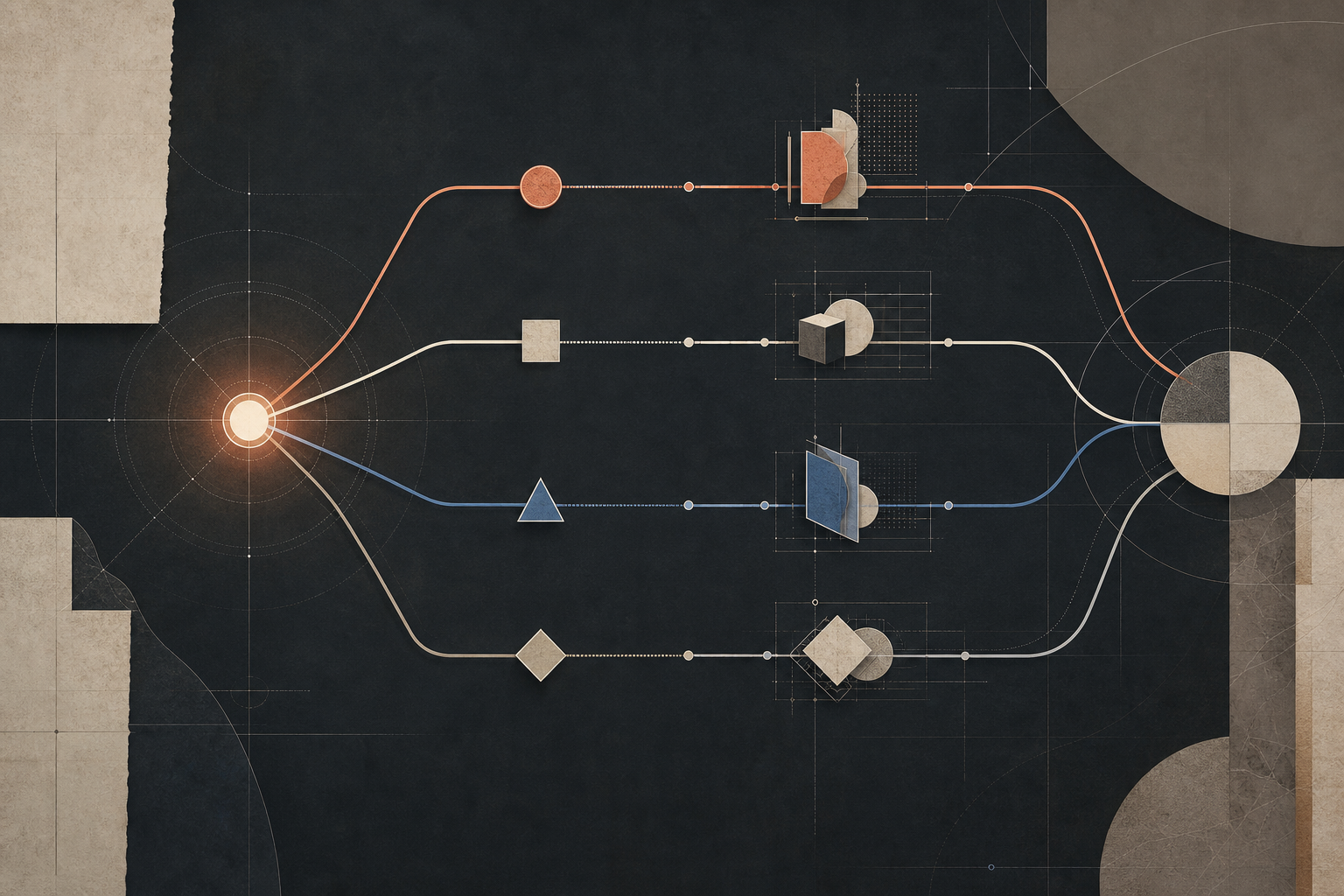
Current product and execution planLocal documentation renderer
Personal JARVIS
Your data. Living applications. One JARVIS.
JARVIS Home turns completed JARVIS work and owner-scoped records into persistent applications. Use them and revise the whole application—or a selected semantic object—through the same Ask JARVIS bar.
Persistent apps · owner-scoped records · literal AI revisions
Generative applicationsBuild, use, point, revise, keep
Personal dataTyped, source-linked, owner-scoped
Build contractPhases, evidence, and stop conditions
One source of truth
The plan is public, bounded, and directly executable.
No JARVIS Home runtime is live yet. The first proof migrates Gym Log and must complete two sequential phone candidates—one Kept and one Discarded—within 72 hours. This page imports each document directly from the repository. Start with the JARVIS Home plan, then review the product boundary, architecture, selective reuse ruling, and build sequence. The source pages govern if a website label ever differs.
Status: approved by Phil Dressler and executing from 2026-08-12.
TODO.md is the only live work list. This document fixes the product boundary,
mechanism, order, acceptance evidence, and stop conditions. The prior
reservation-and-channel release target remains recoverable from Git commit
ff68263dbcd5ef49b8d2a994cf04349266754561.
TL;DR
Build one narrow product:
JARVIS Home turns a person's data and completed JARVIS work into persistent
applications they can use and revise through one Ask JARVIS bar.
Start from an application JARVIS already generated, not from new infrastructure.
Within 72 hours, that application must appear in Home and complete two
sequential real-phone edits through Edit this app → candidate → Preview:
one candidate is Kept and the later candidate is Discarded. Before use counts,
its browser-only storage is migrated to the trusted broker without weakening
the sandbox. Only the four records that this real app and edit loop prove
necessary are added.
Next, build JARVIS Build Room from records that already exist—Tasks,
Attempts, progress events, and verified outcomes. Add semantic object selection
only after application-wide editing works. Add one read-only calendar and a
Today application only after repeated use justifies them.
Replit, Lovable, and Base44 already provide generic prompt-based building,
visual selection, previews, versions, and publishing. JARVIS will not recreate
that category. Its owned value is the private Home library, owner-scoped JARVIS
records, durable Application history across linked coding Tasks, one persistent
composer, and a literal promotion step where nothing becomes live until the
user chooses Keep.
Reservations and unfinished channel parity are parked until the owner decision
at the end of this trial. They receive no parallel build lane during the trial.
The product promise
JARVIS Home contains a small library of persistent applications. Every
application has:
one owner;
one durable identity, one owner-scoped canonical Conversation, originating
Task provenance, and linked edit Tasks;
one live immutable version;
one persistent Ask JARVIS bar;
an explicit application-edit destination;
isolated candidates with Preview, Keep, and Discard; Undo follows after the
first value proof;
optional owner-scoped typed data access;
a visible history of edits and outcomes.
An immutable version is a source-and-build snapshot that is never modified
after creation. An edit creates another version; it does not rewrite the live
one.
The first adopted application is Gym Log, which JARVIS already generated
unattended from an iMessage and published as a verified Task artifact on
2026-08-12. It is chosen over Table for Two because its sandbox migration is
narrower: replace local browser storage with typed broker reads and append-only
session events. Its HTML form is replaced with ordinary input controls and
explicit buttons before adoption; relying on a blocked form submission would
prevent its current JavaScript handler from running. Table for Two
also needs external SMS/OpenTable intent mediation and remains a later artifact.
The first application backed by pre-existing JARVIS records is JARVIS Build
Room. It answers the problem Phil feels now: what is running, why, what
changed, what is blocked, and what outcome was actually delivered. It uses
existing Task, Attempt, event, and outcome records, so it requires no new
personal-data connector.
Build Test and adoption decision
The Build Test asks what a user would notice if owned code were deleted and
the best maintained product were used instead.
Official product documentation shows:
Replit Agent already offers
prompt-based code changes, live Preview, Canvas annotations, checkpoints, and
rollback.
Lovable already anchors
comments to selected elements and sends the page, element, and thread to its
agent; its MCP server
can create, inspect, iterate, and deploy projects programmatically.
Base44 already
offers AI chat, exact element selection, visual editing, preview, version
history, restore, and private-app controls.
Therefore JARVIS does not build a generic AI editor, generic visual canvas,
generic version-control product, or generic hosting platform.
The existing JARVIS Task artifact pipeline remains the first builder because it
already produced two real applications from JARVIS messages, retains Task and
Attempt provenance, and does not require sending personal records to a new
third-party account. If that exact seam blocks the 72-hour loop, spend at most
four hours comparing one maintained builder on four gates: private artifact
handling, API reachability, source portability, and total cost. No personal
data enters that comparison.
Exact mechanism
Trusted Home and isolated generated code
The authenticated JARVIS Home shell owns navigation, the composer, data access,
Preview controls, and promotion. Generated application code never shares that
authority.
Generated code runs in an opaque-origin sandbox—a browser frame treated as
an unrelated origin even when JARVIS supplied its bytes—with:
no access to the parent page or its login state;
no subresource or API network access, form submission, top navigation,
pop-ups, browser storage, service workers, or nested frames; ordinary inputs
and buttons may use JavaScript and the typed broker;
a restrictive Content Security Policy, which is a browser-enforced list of
permitted resource types;
an admission check that rejects forms, links, meta refresh, and direct
navigation APIs, plus a browser test whose observer attaches before the
trusted shell sets the frame source, allows only the one expected document
request for the admitted content-addressed URL, and then fails the Version on
every other request or later frame navigation; this is the alpha egress boundary for
JARVIS-generated, reviewed code, not a claim that arbitrary hostile code is
safe to upload;
one version-bound postMessage broker, which passes only schema-checked
requests and responses between the frame and trusted Home.
Only trusted Home can perform Keep, Discard, Undo, deletion, or data queries.
Keep requires a current authenticated session, a CSRF token—a secret request
token that prevents another page from submitting the action—and a real user
gesture in the trusted shell. Generated content cannot draw over or replace the
Home bar or promotion controls.
Minimum durable records
The first loop adds only:
Record
Purpose
Required invariant
Application
Owner, canonical Conversation, name, originating Task provenance, and live-version pointer
One owner and Conversation; at most one live version
ApplicationVersion
Parent/base, producer kind and reference, source manifest hash, build hash, routes, immutable Binding Set, runtime profile, and evidence
Immutable after creation
ApplicationEdit
Base Version, source Message and Interaction, new coding Task and Attempt, exact instruction, optional semantic anchor, idempotency key, state, and candidate
Cannot silently apply to a different base
ApplicationEvent
Application, owner, family, typed event, schema-valid payload, authorizing Version or trusted actor, predecessor or superseded event, idempotency key, and time
Append-only; projections derive data state and lifecycle history
A Binding Set is the exact, immutable list of typed queries and fields one
version may request. Code, API-schema version, and Binding Set are promoted or
undone together. The fourth record, ApplicationEvent, stores both data.*
events issued through allowed application commands and trusted lifecycle.*
events such as register, preview-ready, keep, discard, undo, revoke, and delete.
Large source, build, and screenshot bytes remain in
content-addressed storage, where the file name derives from its cryptographic
hash. Gym Log's session_added and session_removed events replace
localStorage; no generic personal-data ontology is introduced.
Each Application binds exactly one existing owner-scoped Conversation. Both
Ask JARVIS and accepted Edit this app submissions are canonical Messages in
that Conversation. Every linked coding Task stores that Conversation as its
origin return address. Home reopens the Conversation plus linked Task history
through the Application; two Applications never share a Conversation.
The Binding Set separates read queries from write commands. Gym Log's live
Version may request gym.list_people and gym.list_sessions and issue only
gym.add_session or gym.remove_session. People arrive as opaque IDs,
display names, and initials through the broker; those personal values never
appear in generated source or a coding Task. The trusted broker derives owner, Application, source
Version, event type, and server time; validates the command payload and stable
idempotency key; and appends the corresponding data.session_added or
data.session_removedApplicationEvent. Generated
code cannot supply those authority fields or name promotion, deletion, version,
or lifecycle events. Trusted Home alone writes lifecycle.* events. A candidate
Preview receives synthetic data and has no write commands until Keep makes that
Version live.
The trusted shell counts messages from each frame before JSON parsing or any
server call. More than 120 messages in ten seconds, or ten protocol violations
in ten seconds, revokes and removes that frame; excess messages never reach the
coordinator. The broker rejects before work when serialized request bytes exceed 16 KiB,
JSON nesting exceeds eight levels, a response would exceed 256 KiB, or one
frame has four requests in flight. Queries return at most 100 rows and use a
cursor for more. A durable owner-plus-Application rate bucket allows 60 reads
and 20 commands per minute across all tabs and Versions; excess requests return
rate_limited without a store write. One event payload is at most 8 KiB; one
Application stops accepting commands at 10,000 data events or 16 MiB of stored
personal payload and returns data_limit_reached. Each query or command has a
five-second absolute deadline; the SQLite busy timeout is 250 milliseconds.
Cancellation is checked before the append transaction and immediately before
commit, a timed-out command cannot append later, and a finally path always
releases the frame's in-flight slot. These are product errors, not coordinator
failures.
Every data.* event carries a data-schema version. Each Application Version
names the projector version and event-schema versions it can read. Candidate
verification, Keep, and Undo must successfully project every retained event at
the current data head before promotion; otherwise the operation refuses and
names the first unsupported event. No promotion rewrites old events.
Composer and edit routing
The existing bottom Ask JARVIS bar gains an explicit two-state switch:
Ask JARVIS sends one normal Personal JARVIS interaction and produces
exactly one Interaction Outcome.
Edit this app deterministically selects delegate_task without calling
the Foreground Model Adapter, then stores one canonical user Message and one
Interaction and creates one Application Edit and one normal new coding Task
linked to the Application.
When semantic selection ships, tapping Select part of app chooses a stable
data-jarvis-id and automatically changes the visible destination to Edit
selected part. One submission reaches one destination; there is no hidden
dual send.
The original Gym Log Task and Attempt remain immutable provenance. GA1 runs one
app-specific, deterministic adoption transform owned by the serving release:
it replaces localStorage; rewrites submit, reportValidity, FormData, and
reset behavior as ordinary inputs and explicit button handlers; and replaces
window.confirm deletion with an in-frame confirmation state. It also replaces
every hard-coded owner or collaborator label with the typed gym.list_people
binding and synthetic build fixtures. The first
Version records producer_kind=adoption_migration, the original Task, Attempt,
and source-manifest hash, the serving release commit, the transform version,
the output manifest, and verification evidence. It is not falsely attributed
to the original Attempt and no generic migration framework is added. That
immutable Version begins as a private candidate while the Application has no
live pointer. Trusted Home shows its synthetic-data Preview; the user's first
Keep compare-and-sets a null live pointer to that Version. Adoption never makes
changed bytes live merely because the transform completed.
For each later edit, one transaction writes the canonical Message, Interaction,
Application Edit, normal personal_jarvis Task Input with action=create, new
Task, first Attempt, Context Pack, and Application linkage. The existing Task
Input enums and terminal-Task guards do not widen. Retrying the same stable
idempotency key under the same owner and Application returns that same Message,
Interaction, Edit, Task, and Attempt only when requester, source submission,
base Version, destination, anchor, and instruction match byte for byte. Any
changed field returns idempotency_conflict without exposing prior row IDs.
A store-derived claim query—not only an in-process notification—makes the new
Attempt worker-claimable. Home presents all linked Tasks as one continuous
Application history; it does not claim one native Harness session persists.
Admission checks single-flight before persisting the submission. When another
edit is active, the API returns edit_active, preserves the visible composer
text, and creates no Message, Interaction, Application Edit, Task Input, Task,
Attempt, or Context Pack. An accepted edit exposes its normal authenticated
Task Agent Chat URL; steering that Task remains normal Task control and creates
neither a second Application Edit nor work in another Application.
Before launching the Harness, Task Control verifies the base manifest and
materializes its exact source, tests, Binding Set, API schema, and synthetic
fixtures into the new Task workspace. The Context Pack also carries the ordered
Application edit instructions, Keep/Discard decisions, objective evidence, and
relevant outcomes from earlier linked Tasks. The adopted source contains typed
person bindings rather than personal names, so coding Tasks still receive
synthetic values only. Application Tasks are pinned to Codex;
dedicated admission and worker guards refuse Claude or any other Harness even
though the generic selector supports both. The Task receives a private
candidate contract and must return .jarvis-application-candidate.json, not the
public-artifact contract. On terminal success, JARVIS verifies the manifest and
creates an immutable private candidate Version. One terminal transaction marks
the Attempt and Task complete, creates that Version and its Preview receipt,
appends lifecycle.preview_ready, and queues one idempotent application-specific
candidate_ready return to the Application Conversation. That return contains
only the private Preview locator and evidence; it does not call the public
publisher, create a public URL or provider publication receipt, or emit the
ordinary public-artifact completion outbox. Keep and Discard are later user
decisions, not Task completion. This absence is an acceptance property, not an
implementation convention.
A candidate's Binding Set must equal its base for an instruction that does not
explicitly request a named data capability. Any widening is refused unless the
instruction names it; Preview then shows the exact query, command, and field
diff, and Keep requires a separate trusted-shell confirmation for that diff.
First edit and later reliability
The 72-hour proof permits one active edit per Application and visibly refuses a
second before message persistence. It freezes the base source manifest, Binding Set, schema version, tests,
and synthetic fixtures before work starts. A store-derived worker scans for the
claimable Attempt; an in-memory notification only reduces latency.
The first path must survive restart. A missing or invalid private candidate
manifest honestly fails the Task and Attempt and offers re-run; no provider-
terminal row may remain falsely running. After Build Room is useful, the
reliability gate adds a visible first-in-first-out queue, expiring leases, Undo,
stale-candidate conflict handling, and the remaining crash-point recovery tests.
This keeps generalized infrastructure out of the first user proof.
The later lease lasts 90 seconds and renews every 30 seconds. Fifteen minutes
without a durable non-heartbeat Harness, tool, source, test, or candidate event
shows a visible stale warning but does not interrupt legitimate work. Existing
resource guards and the ordinary authorized-user Task ceiling of at least 24
hours remain the runaway backstops. Recovery may create one honestly labeled
retry. Heartbeats alone do not clear the warning.
JARVIS Home edit lifecycle. The exact text source is available below.Read exact diagram source
The 72-hour tests cover edit commit before notification, restart during the
Attempt, and a missing or invalid private candidate manifest. The later
reliability gate covers build-before-Version, verify-before-Preview, Keep
interruption, queue recovery, and stale candidates.
Verification and promotion
Objective gates verify build success, source/build identity, sandbox policy,
declared functional behavior, phone and desktop rendering, and non-regression.
A critic records evidence about the requested change, but does not claim to
decide subjective taste. Preview labels that evidence honestly; the user's Keep
is the acceptance decision.
Keep performs one compare-and-set transaction: it succeeds only if the live
Version still equals the edit's base Version—or is null for first adoption—then moves the live pointer and
appends the trusted lifecycle.keep event atomically. Discard changes nothing.
The first proof has no concurrent candidate because a second edit is refused.
Undo and generalized stale-base handling follow in the reliability gate.
Personal data
Generated code requests only typed records through the trusted broker. It never
receives connector credentials, session cookies, raw database access, another
person's records, or unrestricted URLs. Coding agents receive schema-valid
synthetic fixtures by default, not real personal values.
A future source connection records both the data owner and the source account,
the granted scopes and fields, and revocation state. Disconnect immediately
blocks new queries. Deleting an Application is the explicit exception to
append-only recovery: it hard-deletes personal ApplicationEvent rows, private
screenshots, attachments, this Application's artifact references, and Versions, then leaves
only the Application ID, owner ID, deletion time, and deleted state. Canonical
Conversation, Messages, Interactions, Tasks, and Task Inputs remain in JARVIS
conversation and work history; the confirmation states that exact retention
before deletion. A physical content-addressed blob is removed only when no
retained owner, Application, Version, or evidence record references its hash;
deleting one Application cannot break another that shares identical bytes.
Full account-history erasure is not claimed by this alpha. Evidence shown in
tests or docs uses synthetic or redacted values.
Alpha scope for targeted editing
The alpha reuses the useful Video Studio idea without claiming its unproven
pixel precision. Selection stores:
exact Application Version + route + stable data-jarvis-id
+ screenshot hash + viewport + scroll + local point + instruction
The stable semantic object is authority; the point is supporting context. If
the object no longer exists, the edit is refused. A visible Select control is
the accessible path on every device; press-and-hold and a finger-offset
crosshair may be added later as faster input.
Drawings, attachments, frame ranges, fixed-resolution source pixels, one-pixel
nudge, exact hold timing, and exact crosshair offset are explicitly deferred.
They ship only after observed use shows that semantic selection is insufficient
and their full capture → record → Task Input → candidate → critic path is
tested.
Critical path and timebox
The fourteen-day clock starts when this plan is published. The seven-day use
window starts after Gym Log's sandbox-compatible broker migration and first real
Home use, no later than the end of Day 3. That still leaves a complete seven-day
window before the Day 14 decision.
Gate
Deadline
User-visible result
GA0 — decision
Hours 0–4
Public plan, exact scope reset, one work list
GA1 — adopt
Day 2
Deterministic release-owned migration produces the first broker-compatible Gym Version with original Task/Attempt provenance; Gym opens from Home and the trial starts
GA2 — edit
72 hours
Two sequential phone Messages create two private Application-linked Codex Tasks; one candidate is Kept and the later candidate is Discarded
GA3 — value + reliability
Day 6
Build Room shows real work; then queue, lease, Undo, stale-base, and remaining crash recovery land
GA4 — target
Day 8
Semantic selection changes one chosen object and refuses a deleted target
GA5 — compound
Day 10
JARVIS Results opens one real completed artifact and reuses Build Room's query with no new connector or storage primitive
GA6 — decide
Day 14
Five uses in one seven-day window; continue, change, or stop decision
One optional read-only calendar connection and Today may begin after GA4 only
if Build Room is being used. It cannot delay GA5 or the Day 14 decision.
The compounding proof requires the second application to add zero connector
setup, zero storage types, and zero runtime primitives; it reuses the same typed
query. One owner-authorized task_fact_corrected event in the existing
canonical task_events append log references an earlier Task fact; the same
source event ID appears through both applications' owner-scoped Task projection
without a rebuild. JARVIS Results has
a distinct job from Build Room: find and open delivered work. The frame may
request only home.open_artifact(artifact_id) for an artifact ID returned by
its allowed query; trusted Home rechecks owner, verified-outcome membership,
and the stored reachable URL before opening a new trusted-shell view. Generated
code never receives or chooses an arbitrary URL. Phil must open one real
completed artifact from it. Elapsed build time is compared with Build
Room, the first application backed by pre-existing JARVIS records.
Acceptance and stop conditions
The direction continues only if all of these are observed from the deployed
immutable release:
one adopted app completes the 72-hour phone edit loop;
live bytes remain unchanged until Keep;
the 72-hour path proves Keep, Discard, restart, second-edit refusal,
store-derived wake, and honest invalid-manifest failure;
the later reliability gate proves Undo, queueing, leases, stale-base refusal,
and remaining crash recovery;
the sandbox cannot reach Home authority or ungranted data;
Build Room is useful from existing records before any connector is added;
one semantic target edit changes the intended object and no named sibling;
JARVIS Results compounds with no new connector, storage type, or runtime, and
opens one real delivered artifact;
Phil uses an app on five of seven trial days and records a decision.
If the 72-hour edit loop fails, stop feature work and repair or replace only the
blocking seam. If repeated use or compounding is absent by Day 14, stop this
direction rather than adding infrastructure. Restaurant work remains parked
until that decision.
Continuous execution contract
Goal
Reach the Day 14 owner decision with deployed evidence, beginning with one
existing application producing two sequential real-phone candidates—one Kept
and one Discarded—within 72 hours.
Non-Goals
The loop does not build a generic AI editor, new coding Harness, new database,
reservation provider, channel cutover, calendar-first data layer, pixel/media
annotation system, marketplace, or autonomous code merger.
Trigger
Phil's 2026-08-12 approval starts the loop. Each next iteration begins only
after the current gate has focused checks, independent review, and its required
live evidence.
Scope
The loop covers GA0 through GA6 in the table above. Local code, documentation,
focused tests, isolated candidates, read-only research, adversarial review,
immutable deployment, and exact live proof are permitted by the standing build
authorization.
Inputs And Required Reading
Read the latest Phil entries in docs/PHIL_PROMPTS_VERBATIM.md, this plan,
PRODUCT_CONTRACT.md, architecture.md, BUILD_CONTRACT.md,
FRIENDS_ALPHA_ACCEPTANCE.md, the current supersession map in DECISIONS.md,
and the active TODO.md item. Before a release, also read current process,
deployment, load, and watcher evidence rather than relying on prose.
State And Memory
TODO.md is the sole work list. Canonical application, edit, Task, Attempt, and
event state lives in SQLite. Source, build, and private evidence bytes live in
content-addressed artifact storage. BUILD_PROGRESS.md records observed proof
and recovery context but never creates work.
Loop Readiness
This is L3 Unattended: the goal is explicit, the first gates are local and
reversible, verifiers and time caps are named, Phil-Gate work is excluded, and
Git plus immutable releases provide rollback. A gate drops to L2 Assisted if a
new human-only or irreversible dependency appears.
Actions
For each iteration: check production answering and machine load; read the
current TODO item; make the smallest user-visible change; run focused tests;
obtain independent adversarial review; deploy the immutable result; prove it on
a real phone path; record evidence; then advance exactly one gate.
After two failed builder attempts on one seam, stop patching and compare
upstream repair, maintained-tool replacement, or deletion under the Build Test.
Verification
Use the applicable HA1–HA8 properties. Each gate requires exact record IDs,
source/build hashes, test output, independent review, phone and desktop use,
fetched deployed bytes, release identity, process start time, and current
outside-process answering evidence. Synthetic or redacted values protect
personal data in evidence.
Caps
One build writer and one active edit per Application.
At load average 10 or higher, one heavy test or browser process.
Two builder attempts before replacement analysis.
Four hours for a maintained-builder comparison if the artifact seam blocks.
72 hours for the first two sequential phone-edit decisions and 14 calendar
days for the owner decision.
One optional calendar connector only after GA4 and repeated Build Room use.
Stop Conditions
Stop on verified GA6 decision, Phil's stop instruction, kill switch, Phil Gate,
workspace conflict, the 72-hour or Day 14 failure rule, or a repeated failure
that cannot progress without a new external fact. A blocker in one lane does
not stop unrelated critical-path work.
Phil Gate Boundary
Stop before reading secret contents, writing under /Users/jarvis/JARVIS,
impersonating a user, weakening the sandbox, or taking an action outside the
standing build authorization. Pre-stage the safe portion, send the required
email-and-text action notification, and continue another permitted gate.
Rollback Or Archive
Git commit ff68263dbcd5ef49b8d2a994cf04349266754561 preserves the prior product
state. Every deployment uses an immutable release with the previous release
retained for rollback. Archive and verify replaced setup material before
deletion. Owner-requested personal-data deletion is the exception: it overrides
recovery and leaves only the permitted non-personal tombstone.
Logging And Closeout
Record observed evidence in BUILD_PROGRESS.md, change work state only through
list/list.mjs, and send Phil a status email after each live gate. Close N-163
only after HA1–HA8 and the owner decision; do not equate plan publication with
product progress.
Risks Handled
The loop handles reviewed generated-code isolation, stale candidates, widened
data permissions, cross-person access, duplicate edits, lost wake-ups, invalid
result manifests, crash recovery, subjective-taste overclaims, hidden process
drift, and test load affecting production.
Accepted Risks
The alpha executes only reviewed JARVIS-generated code behind admission and
zero-egress browser gates; it does not defend against deliberately obfuscated
hostile uploads, which remain excluded. The adopted application may require a
source-manifest conversion; one maintained builder may fail the four-hour
comparison; stable semantic IDs may refuse after an intentional refactor; the
optional calendar may not ship; and a fourteen-day trial may prove the
direction is not useful. Each risk produces an honest stop or refusal rather
than more infrastructure.
Review status: approved product direction; JARVIS Home generative-applications
execution active. This page translates the long-term JARVIS Introduction &
User Promise and Phil's later direct product decisions into current behavior.
Phil's verbatim prompts outrank summaries. GENERATIVE_APPLICATIONS_PLAN.md
defines the current product and loop; FRIENDS_ALPHA_ACCEPTANCE.md defines the
current executable release gate.
TL;DR
JARVIS is your own Personal Agent and application layer: one independently
identifiable JARVIS that turns your connected data into persistent applications
you can use and revise through one Ask JARVIS bar.
The MVP is not a new foundation model, generic agent framework, fixed dashboard,
or hosted team workspace. It is the opinionated product layer between personal
data, normal generated application code, replaceable coding agents, and durable
outcomes.
Product line
Your data. Living applications. One JARVIS.
What users should feel
JARVIS Home remembers which applications exist, what data they use, and which
verified version is live.
Useful answers become persistent screens instead of disappearing into a
transcript.
The user can talk normally, revise an entire application, or point at one
exact interface object without changing tools.
Open-ended edits remain visible and steerable through the existing Task Agent
Chat.
Every candidate is inspectable; Keep, Discard, and Undo behave literally.
A second application can reuse the same source-linked records, so each
connection and correction makes later work cheaper.
1. JARVIS Introduction & User Promise
The canonical onboarding script promises the long-term vision:
one JARVIS with its own computer, phone number, email, and accounts;
fast conversation, durable people and memory, and low-annoyance group behavior;
Task Agents that can do open-ended work and return reachable outcomes;
restaurant reservations that finish, including the correct requester and invitation;
phone access;
#bug as a first-class way to report misses;
teach-once/save-as-skill as vision.
Phil's later direct instruction on 2026-08-12 makes JARVIS Home and generative
applications the current release. The pitch may describe vision. A live JARVIS
reply may claim only verified current behavior.
2. Product boundary
Active release target (JARVIS Home alpha)
The current release includes:
the authenticated JARVIS Home web application;
an application library beginning with one already-generated Task artifact;
the minimum Application, immutable Version, Edit, and append-only
ApplicationEvent records;
a versioned Binding Set and API schema stored on each Version;
ordinary generated web code inside an opaque-origin sandbox;
one persistent composer with visible Ask JARVIS and Edit this app modes;
one canonical owner-scoped Conversation and linked coding Tasks presented as
one Application history;
isolated candidates with Preview, Keep, Discard, and Undo;
JARVIS Build Room over existing Task, Attempt, event, and outcome records;
semantic object selection after the text edit loop works;
a second application that reuses the same typed query with no new connector,
storage type, or runtime primitive;
the existing four Interaction Outcomes when the composer destination is Ask
JARVIS.
Restaurant automation, iMessage direct/group, SMS, email, phone, Factory,
installer/export, and a generic builder do not block this release.
Release order
Delivery follows GA0–GA6 in GENERATIVE_APPLICATIONS_PLAN.md:
publish the decision and exact boundary;
adopt Gym Log in private Home after replacing browser storage and HTML form
submission with the typed broker and explicit controls;
prove two sequential text-edit candidates—one Kept and one Discarded—within
72 hours;
ship Build Room from existing canonical records;
land the Day-6 queue, lease, Undo, stale-base, and crash-recovery gate;
prove semantic object selection;
build a second application from the same typed query;
make the fourteen-day continue/change/stop decision.
The existing conversation and Task foundations remain available, but unfinished
channel expansion cannot pre-empt this sequence.
Vision, not MVP
teach-once/save-as-skill;
restaurant reservations and invitation completion;
six-channel release parity;
a generic no-code or custom-agent builder;
pixel/media annotation and fixed-resolution editing;
a calendar-backed Today application unless repeated Build Room use first
justifies the optional connector;
many local and remote Task Agent types;
user-selected provider and privacy policies exposed as product controls;
amount-capped virtual cards and exact outbound-action previews;
agent-to-agent commerce or marketplace mechanics.
2A. Generative application contract
A generative application is normal application code with durable product
identity, one or more routes, an immutable versioned Binding Set, a persistent
owner-scoped Conversation, linked coding Tasks presented as one Application
history, and a verified live-version pointer.
Generated code runs in an opaque-origin sandbox with no access to JARVIS login
state, parent DOM, browser storage, connector credentials, subresource/API
network access, form submission, top navigation, pop-ups, service workers, or
nested frames. Ordinary inputs and buttons may run JavaScript. Admission rejects
forms, links, meta refresh, and direct navigation APIs; a browser check fails a
Version unless it observes exactly the expected admitted document request and
then zero other requests or later frame navigations. This alpha boundary admits
reviewed JARVIS-generated code, not arbitrary hostile uploads.
The version-bound trusted broker exposes separate schema-checked read queries
and write commands. It derives owner, Application, Version, server-owned event
type, and time for every append-only data event; generated code cannot forge
authority or lifecycle events. Candidate Previews receive synthetic data and no
live write commands.
The trusted shell bounds message bursts before parsing or server work. The
broker bounds bytes, nesting, rows, concurrency, durable rate, stored event
volume, and each operation's deadline. A timed-out command cannot append later.
Every data event names a schema version, and promotion must project all retained
events under the target Version. Generated source and coding Context Packs use
typed person bindings and synthetic values rather than hard-coded personal
labels.
Every selectable object exposes a stable data-jarvis-id. A targeted
instruction binds exact Version, source manifest hash, route, stable object,
screenshot, viewport, scroll, and local point. Semantic identity is authority;
pixel/media precision, drawings, attachments, and ranges are deferred.
An edit cannot change live code directly. The qualified coding Task builds an
isolated immutable candidate. Objective gates check source/build identity,
sandbox policy, declared behavior, non-regression, and phone/desktop rendering;
critic evidence does not claim to decide subjective taste. Only an authenticated
trusted-shell user gesture may Keep with CSRF protection and a base-version
comparison. Discard changes nothing; Undo restores code and Binding Set together.
Edit this app bypasses foreground model judgment and deterministically produces
one delegate_task Interaction, a normal new linked Task/Attempt, and one
private candidate. The Task's terminal return points to private Preview in the
Application Conversation and never invokes the public publisher; Keep only
moves the private live pointer. A benign edit cannot widen its Binding Set, and
any explicitly requested widening requires a visible exact permission diff and
separate Keep confirmation.
Deleting an Application removes its personal app events, Versions, private
evidence, and artifact references after disclosing that canonical Conversation
and Task history remain. Shared physical bytes survive until their last retained
reference.
The total property is: a user may navigate away during a build, continue using
JARVIS, return to a durable candidate, understand exactly what changed, Keep or
Discard it without risking live, and reuse the same data in another application.
3. The Interaction Outcome contract
The collective term is Interaction Outcome. The code field is interaction_outcome. The only values are:
Interaction Outcome
Exact contract
Visible actor
answer_now
Answer in the current conversation without invoking a capability or creating a Task Agent
Personal JARVIS
ask_clarifying
Ask the minimum missing question that materially changes the outcome or execution
Personal JARVIS
use_capability
Execute a bounded capability with typed inputs, authority rules, verification, and a receipt
Personal JARVIS
delegate_task
Create a durable Task, or continue an existing correlated Task, with a separately steerable Task Agent Chat
Personal JARVIS introduces and returns the Task Agent
These exact terms appear in product copy, architecture, code, telemetry, tests, and documentation. “Action run,” “hand-off,” “delegated run,” and “interaction model” are not competing formal names.
Immediate, clarifying, and delegated experiences
System 1 and System 2 remain familiar explainer aliases only:
Immediate experience / System 1:answer_now and use_capability. JARVIS remains the only visible actor.
Clarifying experience:ask_clarifying. It is neither System 1 nor System 2.
Delegated experience / System 2:delegate_task. A separately steerable Task Agent and Task Agent Chat exist.
The router never classifies work from a subjective feeling. The existence of a separate Task Agent is the mechanical boundary.
If a Capability Run cannot finish in the current interaction turn, JARVIS sends one progress acknowledgement and later returns the verified result through the same origin. It remains use_capability; provider latency alone does not create a Task Agent.
The grey area
JARVIS uses these rules:
If missing information would change the goal, scope, recipient, cost, or irreversible action, choose ask_clarifying.
If JARVIS can answer now, choose answer_now.
If a typed, bounded capability can finish the job without iterative judgment or future steering, choose use_capability.
If the work needs planning, iteration, open-ended tool use, a persistent session, or steering, choose delegate_task.
If both an immediate answer and a deeper Task may help, answer the immediate part and explicitly offer delegation. Do not silently create work the user did not request.
4. The foreground AI
Personal JARVIS is always AI-backed for an eligible interaction. The Interaction Agent receives:
normalized channel, conversation, reply target, attachments, and exact per-message sender;
JARVIS identity and persona;
requester identity and authority;
relevant conversation context and memory;
available capabilities and Task Agent options.
When foreground judgment succeeds, it chooses exactly one Interaction Outcome.
If that pipeline fails before a valid outcome is admitted, the durable
Interaction instead reaches failed with zero outcomes under the failure path
below. Literal channel eligibility rules may reject unaddressed group traffic
before the model so JARVIS stays quiet; that traffic may become permitted
context but not an interaction.
The exact outcome payload is discriminated by interaction_outcome:
answer_now carries only reply;
ask_clarifying carries only question;
use_capability carries only capability and schema-validated arguments;
delegate_task create carries task_mode, goal, constraints, and
acceptance_criteria;
delegate_task continuation carries task_mode, requester-authorized
task_id, and one task_action; only answer_question also carries
question_id.
Task continuation passes the canonical current Message to Task Agent Control.
The Interaction Agent cannot rewrite the user's instruction before forwarding
it. Exact text, reply metadata, and ordered attachment references become one
durable Task Input. An explicit requester-owned Task ID or native reply wins;
if the target remains ambiguous, JARVIS asks one clarification before mutation.
The response may also carry bounded person_updates for the requester's
explicit first-person statement of their own name, phone, or email. JARVIS
validates the cited message evidence and stores the fact with the primary
outcome; it never turns a learned fact into a verified login Handle. An invalid
optional update is rejected without suppressing the valid primary outcome.
This sidecar can accompany any of the four outcomes; it is not a fifth outcome.
Invalid output, a runtime failure, cancellation, or deadline produces no
Interaction Outcome and starts no action. One transaction marks the pending
Interaction failed with the observed source and inserts one exact-origin
failure event. Replay does not duplicate it.
The target foreground makes one non-streaming request through the JARVIS-owned
Foreground Model Adapter. The current N-15 implementation sends no provider
credential and no tools, uses strict structured output through the adopted
loopback Provider Spend Gateway, and applies one 25-second deadline. The
request declares a conservative estimate from its UTF-8 byte token upper bound
plus full output allowance. The gateway injects the JARVIS model credential,
reserves that estimate under provider/daily estimated-spend caps, and
propagates abort upstream; it does not reconcile final OpenAI billed cost.
JARVIS then normalizes the provider envelope and applies its existing exact
local schema and atomic admission; provider structure never weakens the product
contract. The initial live-canary target is OpenAI Responses with
gpt-5.4-mini at low reasoning effort. A different provider may replace it
behind the same owned adapter after equivalent proof.
Foreground judgment never opens an Agent Harness session. Open-ended execution
still requires delegate_task. Codex is the only formally qualified Task
Harness. Claude remains selectable and has failover plumbing, but its steering
delivery is unqualified; application edits cannot route to it until the
unchanged Harness qualification passes. Harness status does not turn foreground
judgment into a tool-using worker.
5. Task Agent Chat
Task Agent Chat is the exact product name. It is the JARVIS-owned,
owner-facing experience for watching and steering a real qualified Task session.
An initial delegate_task produces:
immediate acknowledgement in the origin conversation;
a stable, phone-reachable Task URL;
visible plan for multi-step builds or consequential work;
streamed progress and material tool activity;
attachments and artifacts;
user steering during execution;
awaiting_user questions in both Task Agent Chat and the origin conversation;
stop, resume, and continue;
explicit done, failed, cancelled, or waiting state;
verified outcome and evidence;
durable transcript;
one logical return event to the exact origin conversation, delivered through a durable outbox with a stable idempotency key.
The stable Task URL is composed from the deployment’s authenticated web base
plus /tasks/{task_id} and stored before acknowledgement delivery. The docs
host is never the Task runtime. The locator is not authority: the authenticated
Person must equal the immutable Task requester.
An eligible later message that answers, steers, stops, resumes, retries, or
continues a requester-owned Task keeps the same Task and does not create a
duplicate. JARVIS persists the exact control and visible user event before
forwarding it. Continuing terminal work creates a new, honestly labeled
Attempt in the same Task Agent Chat. Input inside Task Agent Chat is not a new
Personal JARVIS Interaction; Task Agent Chat remains a projection of persisted
Task events rather than a second conversational send path.
Behavior and interaction-quality parity bar
Task Agent Chat targets the user-visible behaviors and interaction quality that
make Codex desktop and Claude Code effective. It does not copy vendor branding
or require pixel identity:
streamed commentary and clear current activity;
plan visibility and plan changes;
material tool and file activity;
steering without starting over;
questions with preserved context;
attachments, files, diffs, previews, and reachable artifacts;
stop, resume, retry, and continue;
durable history with clear waiting, done, failed, and cancelled states.
“Parity with Codex/Claude Code” is not accepted as a test result unless all
eight behaviors are proven and a separate visual adversary passes responsive
desktop and phone states for hierarchy, readability, streaming, composer
quality, keyboard/touch use, overlap, clipping, and dead controls.
The first live Task-site proof is causal, not a comparison to an existing page:
a fresh challenge arrives in a real phone steer after Task start; that path is
absent before deployment; the same Attempt writes and deploys the artifact with
a Task/Attempt/hash receipt; and a later phone fetch matches the source bytes.
Behavioral parity is not permission to weaken the underlying Harness. Codex
retains its normal tools, execution depth, steering, and long-run ability in
the current release; a future Claude path must meet the same bar. Every
authorized friend receives the same capability. A 24-hour-or-higher ceiling is
a runaway backstop, not a reduced Task tier.
“One logical return event” does not claim that a network can guarantee literally exactly-once delivery. Each Task milestone has one stable origin_return_id; retries reuse it, durable send state prevents a second JARVIS event, and channel-level deduplication is used where supported.
Planning policy
Multi-step builds and consequential world-changing work receive a visible plan before execution. A one-step bounded research Task does not receive a ceremonial long plan. Planning is proportional to coordination risk.
6. Agent Harness selection
An Agent Harness is a program such as Codex or Claude Code that performs
open-ended agent work. Codex is the only qualified Harness in the current MVP.
The selector therefore resumes an existing Codex session when possible and
otherwise starts Codex while recording that exact reason.
After Claude Code independently passes the unchanged Harness qualification,
selection remains mechanical: Task continuity, explicit user choice, required
capability, truthfully observable quota, then configured default. No learned
quality scoring, task-type benchmarking, complex credit router, or Factory
integration is part of the current MVP.
7. Context and clarification
The Interaction Agent asks obvious outcome-changing questions before delegation. A Task Agent may ask later when new ambiguity emerges during execution.
The Context Pack is complete for the Task, not a replay of the user's entire history. It contains the original request, requester and authority, origin, clarifications, goal, constraints, acceptance criteria, relevant excerpts and references, attachments, workspace, outcome destination, JARVIS instructions, and secret exclusions.
Large images, logs, and tool outputs stay in durable storage and enter model context only by reference or relevant excerpt. This protects subscription quota without deleting the user's record.
8. Transcript and continuation contract
JARVIS retains:
user-visible conversation;
plans and plan changes;
material progress and tool events;
Task Agent questions and user steering;
artifacts and reachable links;
decisions, evidence, and terminal status;
Agent Harness name and native session identifier;
a compact continuation brief.
JARVIS does not claim to store hidden model reasoning. Completing a Task archives active execution; it does not delete history to “save credits.” Idle stored transcripts do not consume model quota.
When a user returns to an old app or Task:
resume the same native Harness Session when supported and healthy;
otherwise create a new Task Attempt from the continuation brief, current artifacts, decisions, and relevant transcript excerpts;
show the attempt boundary honestly while keeping one continuous JARVIS Task Agent Chat.
9. JARVIS-owned identity
Personal JARVIS is an independent operational party:
its own Mac;
its own phone number;
its own email;
its own service accounts;
its own visible name and persona.
It never impersonates the user or operates through a user's personal world-facing account. A user's Codex or Claude subscription may authorize computation on that user's instance; that is an execution entitlement, not JARVIS assuming their identity.
Identity, persona, and people remain separate:
IDENTITY.md defines stable agent identity and boundaries;
SOUL.md defines voice and personality;
INSTRUCTIONS.md defines the stable runtime Interaction Agent contract;
AGENTS.md instructs build and operator agents;
person records hold per-user memory and authority;
the Identity Vault holds JARVIS-owned world-facing channel and capability credentials outside the repository and outside model context;
owner Codex and Claude authentication remains in each Harness's native user store and is never copied into the Identity Vault.
Before first live startup, one exact versioned import seeds canonical People,
normalized verified/unverified Handles, and bounded profile facts into SQLite
in one transaction. Its receipt and seeded rows must rehash before an
idempotent replay; a conflicting or corrupt second seed fails closed. The
deployment-only importer may convert the old read-only canonical people export
once; live runtime never reads it. A Handle names its channel, JARVIS account,
and email/phone/opaque kind. Exact verified tuples authorize web or Messages;
Messages may identify a sender by phone or Apple Account email. Onboarding then
appends requester facts from explicit message evidence. Source Message order,
not model completion order, selects the current value. If a person's name,
phone number, or email is already known, JARVIS reuses it and never asks for
that field again. A learned fact never grants login or channel authority; only
a separately verified Handle does.
10. Capability contract
A Capability is a bounded operation Personal JARVIS can invoke. Its implementation may be:
a JARVIS-built tool;
a Communication Runtime Host plugin or tool;
an MCP server;
a supported API;
a browser worker;
a future remote agent adapter.
A Skill is reusable instruction for how to use registered tools. It can guide a Capability workflow, but it does not itself implement a new callable action.
JARVIS does not need to own every line of implementation. JARVIS owns:
whether the action is authorized;
typed inputs and required confirmation;
invariants that refuse unsafe or invalid actions;
provider selection;
verification;
receipts and evidence;
user-visible outcome.
Every accepted use_capability creates a durable Capability Run before a
provider call. It records typed input, confirmation, attempts, provider
idempotency, receipts, and recovery. Safe read-only work can retry after a
crash. A world-affecting action with ambiguous provider acceptance becomes
outcome_unknown and never blindly repeats. Later confirmation or missing
information resumes the same Capability Run.
This is the Build Test made concrete: reuse the operation, build the felt product guarantee.
11. Reservation vision contract
A future reservation capability is complete only when JARVIS has:
identified the exact requested restaurant and street address;
obtained the requested date, time, and party size or asked a clarification;
shown one explicit confirmation with the address;
booked the exact confirmed restaurant without double-booking;
verified the confirmation;
added the requester as the default guest;
invited every named guest whose address is already known, or asked for the missing address before claiming the invitation is complete;
returned the OpenTable confirmation or invitation link;
stored evidence and replied in the origin conversation;
supported honest failure and recovery;
preserved a path to modify or cancel later.
The existing booking driver sometimes works and remains valuable evidence. It
is neither worthless nor proven. All reservation work, including supported-
provider research, is parked until the GA6 owner decision.
12. Future enabled-group contract
When the group lane returns after the GA6 decision, its enabled-lane promise is:
JARVIS speaks when a message contains JARVIS;
JARVIS speaks when the message replies directly to a JARVIS message;
JARVIS speaks when work requested in that thread finishes, fails, needs a decision, or is later found wrong;
every other group message receives no Interaction and no outbound reply.
Default silence is a gate before that future group lane is enabled. A real
unaddressed-group message must prove that the deployed release creates no
Interaction or reply before the group lane is enabled.
Exact per-message sender attribution is also a gate before future group
use_capability and delegate_task are enabled. It is not a JARVIS Home alpha
release gate. The requester controls memory, authority, future reservations,
Task ownership, and return routing.
Every enabled-lane message containing #bug creates one immutable Feedback record linked to its source Message and one pre-drafted Pending item in TODO.md through the idempotent list/list.mjs writer. The item uses one fixed recommendation and trusted repair instruction; it links to the exact report in Feedback and invokes no second model. Feedback is evidence, not work status. An unaddressed group #bug follows the same path silently and creates no Interaction; addressed messages may receive an ordinary reply.
Historical Phase B work selected pinned imsg rpc v0.13.1 behind a thin owned
Channel Adapter as the Messages target. That lane is deferred by D228. If it
resumes, its transport metadata must prove live resolution from every Messages
sender to the correct canonical Person before group use_capability or
delegate_task ships.
13. Web and Outcome Library
The web app is JARVIS-owned. It is not an external provider and not merely chat.
It contains:
Personal JARVIS conversation;
Task Agent Chats;
live and historical outcomes;
persistent apps the user chose to keep;
one-time artifacts archived but still reachable;
application versions, edits, promotions, and verification receipts;
transcript-linked #bug evidence, never work status.
The Outcome Library is a projection of canonical JARVIS records, never a separate store. A reachable artifact and its proof remain connected to the conversation and Task that created them.
JARVIS Home never silently evicts a user-visible outcome. Application deletion
has the scoped behavior in section 2A: it removes that Application's personal
events, Versions, private evidence, and artifact references while retaining and
disclosing canonical Conversation and Task history; shared bytes survive until
their last retained reference. Full account-history erasure is not implemented
or claimed in this alpha. Connector disconnect or grant revocation blocks new
queries immediately.
14. Ownership, privacy, and portability
“Own your agent” requires more than choosing OpenAI or Anthropic. The target
portability contract covers:
identity configuration and persona;
person records and memories;
conversation and Task transcripts;
Task records, attempts, decisions, and evidence;
outcomes and artifact references;
capability configuration;
provider and Harness adapter settings.
The user chooses which providers and capabilities are enabled. Every record
preserves provider and data provenance. JARVIS treats external content as data,
never instructions. Export is not yet implemented and is not claimed as current
behavior.
A future portability phase defines one documented archive—JSON or Markdown
records plus an artifact manifest—and proves a round-trip import into a clean
instance. External links are exported with last-known reachability and are
never represented as locally owned files.
15. What JARVIS uniquely adds
Most primitives already exist. The defensible current integration is:
one persistent library of private personal applications;
source-linked typed personal records reusable across applications;
one Ask JARVIS bar with explicit chat, whole-app, and selected-object
destinations;
semantic edit intent bound to an immutable base version, with spatial input
deferred until observed use requires it;
a consistent coding Task over qualified, replaceable Harnesses;
isolated candidates with verified Preview, Keep, Discard, and Undo;
a second application that becomes cheaper because the first connection,
record, correction, and edit already exist.
JARVIS is defensible as an opinionated product and integration contract, not as a claim that it invented channels, memory, plugins, browser automation, or agent sessions.
Docs that become operational state or a second backlog
Privacy explanation
Pally
Plain-language provider and data explanation
Vendor-only provider choice
US-English voice is a user preference and persona default, not a technical moat. Quality bars constrain user-visible behavior; they do not justify copying an entire competitor stack.
17. Honest status
Current
Phil's 2026-08-12 approval of JARVIS Home and generative applications as the
current critical path;
the bounded and machine-validated GENERATIVE_APPLICATIONS_PLAN.md;
three completed independent old-repository reuse reviews that retain the
composer, lifecycle, library, and targeting concepts while rejecting the old
builders and executor;
the prior product contract archived at Git commit
ff68263dbcd5ef49b8d2a994cf04349266754561;
Historical foundation evidence
canonical original prompts, Q&A, decisions, promise, architecture, and guards;
Phil's explicit “GO” and the active bounded execution goal;
Hermes common-control-plane preflight elimination from primary documentation and independent review;
OpenClaw native-Codex common-control-plane preflight elimination from pinned source because TUI/WebChat cannot bind it;
two archived, rejected Phase A evidence-layer drafts that failed the Build Test before any standalone candidate ran;
OpenClaw ACP v2 installed and closed FAIL at R0 because candidate-isolated Codex OAuth required a non-VoIP phone number;
one non-qualifying pre-v3 stock OpenClaw-to-Codex handshake succeeded through the owner's native entitlement and proved only that setup seam;
repaired OpenClaw ACP v3 launched real Codex and returned R0_AUTH_OK, then closed FAIL at R0 because stock chat.send could not present the operator.admin scope required by /acp status;
two independent source reviews confirmed the v3 permission mismatch, and teardown left protected services unchanged;
an evidence-driven C4 revision that selects pinned imsg rpc v0.13.1 as the Phase B Messages Communication Runtime target, records it as not installed or qualified, keeps its thin adapter inside Personal JARVIS Application, and leaves OpenClaw eligible only for a later individually qualified seam;
standalone acpx plus the frozen thin compatibility patch passed the exact 32-call Codex qualification under final manifest a13e816a16b1403a1417dfbadb8d50e1ef2a91dfcb5cc3bba69571629a53dcdc, with three independent final PASS reviews;
D135's bounded AbortSignal extension passed its focused tests, timed cleanup proof, and fresh unchanged 32-call Codex matrix under final evidence manifest 4512f3afbea7f7c88d3d3fadcf588d466ac381d2efdd2075abee49db48db7659, with three independent final passes;
the exact delegated-Task Harness verdict recorded as
PROVISIONAL_CODEX_ONLY — NOT DUAL_HARNESS_QUALIFIED, which qualifies the
Codex Task boundary for the current release without granting Claude any credit;
the prior foreground acpx assumption refuted because the pinned Codex ACP
adapter does not apply the requested system prompt or tool allow-list;
a direct, tool-free Responses foreground seam implemented with hermetic
request, schema, body-bound, failure, and deadline tests; live provider proof
remains unrun;
Claude Code qualification recorded as NOT_RUN; credits are reported
restored and the unchanged qualification is queued after N-15;
an old booking driver with partial real success in the read-only repository;
a public documentation website rendering the canonical Markdown.
Authorized execution sequence
GA0 contract and public plan;
GA1 adopt an existing Task artifact in private Home;
GA2 complete two sequential text-edit candidates, Preview, one Keep, one
Discard, store-derived wake, restart, and honest manifest failure within 72
hours;
GA3 Build Room from existing Task records, followed by queue, lease, Undo,
stale-base, and remaining crash recovery;
GA4 semantic object selection;
GA5 JARVIS Results reuses Build Room's query without new infrastructure and
opens one real completed artifact;
GA6 fourteen-day owner decision from a completed seven-day use window.
Reservation and unfinished conversation-channel work remain preserved but
paused. They return only after the GA6 evidence and owner decision.
Vision
general Personal Agent configuration;
many Remote Agent Adapters, including remote agents when supported APIs exist;
teach-once/save-as-skill;
user-configurable privacy policy;
constrained payments and action previews;
evidence-gated expansion to additional people and channels.
18. Non-goals and accepted risks
No generic no-code or general agent builder in MVP.
No OpenClaw fork, no acpx fork, and no OpenClaw-plus-Hermes dual kernel. The permitted acpx compatibility patch is upstreamable, limited to active steering, structured questions, complete plans, and pre-handle abort, and capped below 240 gross changed production lines.
No Factory integration in the current release.
No installer/export gate in the current release.
No autonomous self-merging loop.
No token, DAO, marketplace, or crypto dependency.
No complex learned Harness router.
No reservation provider or browser automation on the current MVP critical
path.
Reservation research remains parked until after the GA6 owner decision.
One read-only calendar connector may start after GA4 only if repeated Build
Room use justifies it; it cannot block GA5 or GA6.
No new graph database, vector database, or data warehouse before GA6.
Closed products may be reference bars but never silent foundational dependencies without a supported programmatic contract.
Approval sentence
Phil's 2026-07-28 “GO” authorizes bounded autonomous build execution. His
2026-08-12 direction replaces the current release target with JARVIS Home and
generative applications. GENERATIVE_APPLICATIONS_PLAN.md and
FRIENDS_ALPHA_ACCEPTANCE.md define that target. The authorization covers
spending, public exposure, JARVIS-owned accounts, OAuth, personal-data access,
and exact clean-slate production control required by this build. It does not
permit writes to /Users/jarvis/JARVIS, reading or printing secret contents,
impersonation, broad process-kill commands, or skipped acceptance proof.
Status: target architecture. No JARVIS Home runtime is live yet.
Phil approved the generative-applications direction on 2026-08-12. The prior
reservation and all-channel release architecture remains recoverable from Git
commit ff68263dbcd5ef49b8d2a994cf04349266754561.
GENERATIVE_APPLICATIONS_PLAN.md defines order and timeboxes;
FRIENDS_ALPHA_ACCEPTANCE.md defines observed release proof.
Rulings
Start by adopting one existing Task artifact, not by building a platform.
Trusted Home and generated code never share browser authority.
Add only Application, Application Version, Application Edit, and append-only
ApplicationEvent records for the first loop.
Each Version owns its immutable data Binding Set and API-schema version.
One Application edit builds at a time. The 72-hour proof refuses a second;
visible queueing follows after Build Room.
Store state, not process notification, is the source of runnable work.
Codex is formally qualified. Claude is not eligible for application edits
until its steering delivery passes the unchanged qualification.
Reservations, channel parity, generic editor features, and media precision
do not block JARVIS Home.
System context
JARVIS Home system context. The exact text source is available below.Read exact diagram source
%% title JARVIS Home system context
flowchart TB
person(["Phil\napplication and data owner"])
jarvis["Personal JARVIS + Home\nconversation · applications · Tasks · outcomes"]
harness["Qualified coding Harness\nCodex first"]
model["Foreground model service"]
source["Optional personal-data source\nread-only after first value proof"]
person <-->|"ask · use · edit · preview · keep"| jarvis
jarvis <-->|"durable coding Task"| harness
jarvis <-->|"structured foreground judgment"| model
jarvis <-->|"owner-scoped read"| source
A URL is a locator, not authority. Authentication resolves the exact Person,
and every Application and query rechecks that owner.
Containers
JARVIS Home container boundaries. The exact text source is available below.Read exact diagram source
%% title JARVIS Home container boundaries
flowchart TB
user(["Authenticated person"])
codex["Codex Harness"]
subgraph trusted["Trusted Personal JARVIS boundary"]
coordinator["Coordinator\nconversation · auth · outcomes · outbox"]
home["JARVIS Home shell\nlibrary · composer · trusted controls"]
api["Application API\nowner checks · typed broker · edit admission"]
tasks["Task Agent Control\nTask · Attempt · Input · session"]
verifier["Verification gate\nbuild · security · function · rendering"]
records[("Canonical SQLite store")]
artifacts[("Content-addressed artifacts")]
watcher["Outside-process answering monitor"]
end
sandbox["Opaque-origin generated-app sandbox\nno parent authority · no API network/storage/submission"]
user <-->|"authenticated use"| home
home <-->|"conversation"| coordinator
home <-->|"app state and trusted actions"| api
home <-->|"version-bound messages"| sandbox
api <-->|"typed response only"| sandbox
api -->|"durable edit input"| tasks
tasks <-->|"qualified session"| codex
tasks --> verifier
verifier --> artifacts
verifier --> records
coordinator <--> records
api <--> records
tasks <--> records
watcher --> coordinator
Trust boundary
The Home shell owns authentication, navigation, the Ask JARVIS bar, Preview,
Keep, Discard, Undo, delete, and the data broker. Generated application code
runs in an iframe without allow-same-origin, top-navigation, pop-up, download,
or storage authority. Ordinary inputs and buttons may run JavaScript. Its
Content Security Policy blocks subresource and API network access, workers,
nested frames, form submission, and external resources.
Admission rejects forms, links, meta refresh, and direct navigation APIs. The
browser observer attaches before trusted Home sets the frame source, allows the
one expected document request for the admitted content-addressed URL, and fails
the Version on every other request or later frame navigation. This alpha
boundary admits reviewed JARVIS-generated code; it does not claim to safely
execute arbitrary hostile uploads.
The only crossing is a version-bound postMessage protocol:
The broker rejects unknown message sources, versions, queries, commands,
parameters, and fields. A candidate Preview receives synthetic data and no
write commands. Generated code cannot supply owner, Application, event type, or
lifecycle action, and never sees session cookies, CSRF tokens, connector
credentials, raw SQL, secret paths, unrestricted URLs, or another person's
records.
The trusted shell counts each frame's messages before parsing or server work.
More than 120 messages in ten seconds or ten protocol violations in ten seconds
revokes and removes the frame, so a generated message loop cannot flood the
coordinator. A frame has four requests in flight; the durable
owner-plus-Application bucket permits 60 reads and 20 commands per minute.
Requests are at most 16 KiB and eight JSON levels; responses are at most 256 KiB
and 100 rows. Event payloads are at most 8 KiB, and one Application accepts at
most 10,000 data events or 16 MiB of personal event payload.
Every broker operation has a five-second absolute deadline and a
250-millisecond SQLite busy timeout. Cancellation is checked before the append
transaction and immediately before commit. A timed-out command cannot append
later, and a finally path releases its in-flight slot. Every data event has a
schema version; verification, Keep, and Undo project all retained events through
the target Version's declared projector before promotion.
Keep is issued only by a trusted-shell control after a real user gesture. Fixed
trusted chrome sits outside and above the clipped frame and displays a distinct
JARVIS Preview origin label. Generated code may draw a lookalike inside its own
frame, but cannot overlay the trusted chrome or reach the server action. The
trusted handler alone sends authenticated Person, CSRF token, Application ID,
base Version ID, and candidate Version ID.
Canonical records
JARVIS Home canonical record relationships. The exact text source is available below.Read exact diagram source
Stores ID, owner Person, one canonical owner-scoped Conversation, name, slug,
originating Task/Attempt provenance, live Version pointer, state, and timestamps.
One owner and Conversation are immutable. At most one Version is live. Both
composer modes persist Messages in this Conversation, every linked coding Task
uses it as the origin return address, and two Applications cannot share one.
Application Version
Stores Application, parent/base Version, producer kind/reference, source
manifest hash, build hash, routes, runtime profile, immutable Binding Set,
API-schema and projector versions, creation class, and evidence. A normal candidate
names its Task Attempt. The first Gym Version names
producer_kind=adoption_migration, the original Task/Attempt/source hash,
serving release commit, transform version, and output hash. A source manifest
hash—not a Git commit—is authoritative. Version rows are insert-only:
candidate, preview-ready, live, discarded, and undone are projections of the
Application live pointer plus append-only lifecycle events, never mutable
Version state.
A Binding Set lists exact typed queries and returned fields permitted for
that Version, plus a separate allowlist of typed write commands. Code, Binding
Set, and schema version are promoted and undone as one unit. A benign edit
cannot widen the base Binding Set. An instruction must explicitly name a new
data capability; Preview then shows the exact query, command, and field diff,
and Keep requires a separate trusted-shell confirmation for that widening.
Application Edit
Stores Application, base Version, requester, source Message and Interaction,
new coding Task and first Attempt, exact instruction, optional semantic anchor,
idempotency key, lifecycle state, candidate Version, lease, retry count, and
evidence. One idempotency key maps to one logical edit.
Application Event
Stores Application, owner, family, authorizing live Version or trusted actor,
server-owned event type, schema-valid payload, predecessor or superseded event,
stable idempotency key, and server time. It is append-only. data.* events
project current app data. Trusted Home alone writes lifecycle.* events for
register, preview-ready, keep, discard, undo, revoke, and delete. Gym Log uses
only gym.list_people, gym.list_sessions, gym.add_session, and
gym.remove_session; the latter
two map inside the broker to data.session_added and data.session_removed.
Generated code cannot choose a different event type or forge owner, Version,
promotion, deletion, or lifecycle fields.
Promotion, discard, undo, recovery, revoke, and delete are append-only
Application events. A Keep transaction compares the current live pointer with
the edit's base, moves it once, and writes the event atomically.
Large source, build, screenshot, and attachment bytes live outside SQLite in
content-addressed storage. Owner deletion removes this Application's personal
events, Versions, evidence, and blob references and overrides recovery;
canonical Conversation and Task history remain and the confirmation discloses
that retention. A physical blob is removed only when no retained owner,
Application, Version, or evidence reference uses its hash. A non-personal
tombstone may preserve the Application ID, owner ID, deletion time, and state.
Application adoption and creation
Existing application adoption flow. The exact text source is available below.Read exact diagram source
%% title Existing application adoption flow
sequenceDiagram
participant H as Trusted Home
participant A as Application API
participant R as Record store
participant F as Artifact verifier
participant S as Opaque sandbox
H->>A: Adopt verified Gym artifact
A->>F: Deterministic release-owned migration and verification
F-->>A: Hashes, routes, runtime profile, evidence
A->>R: Create Application + Conversation + candidate Version + preview event
H->>A: Open synthetic-data Preview
H->>A: Keep with null-base compare-and-set
A->>R: Set live pointer + append keep event
H->>A: Open live Version
A-->>S: Self-contained bytes + restrictive policy
S-->>H: Render with zero trusted authority
Gym Log is adopted first after replacing localStorage with the typed broker;
replacing its HTML form and browser confirmation with ordinary inputs, explicit
buttons, and in-frame confirmation; and replacing hard-coded personal labels
with gym.list_people plus synthetic build fixtures. The release-owned
transform, not the original Task Attempt, produces the changed bytes. Adoption
starts private and cannot set the live pointer until the user's Keep. A later
new application uses the same records but starts with a durable Task Input and
creates a candidate before promotion.
Edit lifecycle
Durable single-flight application editing. The exact text source is available below.Read exact diagram source
%% title Durable single-flight application editing
sequenceDiagram
participant U as User
participant H as Trusted Home
participant C as Application Conversation
participant A as Application API
participant R as Record store
participant T as Task Agent Control
participant V as Verification gate
U->>H: Choose Edit this app and submit instruction
H->>A: Exact Application, base Version, instruction, idempotency key
A->>A: Single-flight check before persistence; bypass foreground model
A->>R: Atomically commit Message + delegate_task Interaction + Edit + new Task/Input/Attempt
R-->>C: Persist in canonical Application Conversation
T->>R: Store-derived claim of new Attempt
T->>T: Materialize base + tests + bindings + synthetic fixtures + ordered app history
T->>V: Isolated candidate source and build
V->>V: Objective security, build, function, and rendering gates
alt objective gates pass
V->>R: Atomically complete Task/Attempt + Version + Preview + candidate_ready return
H-->>U: Isolated Preview with trusted Keep and Discard
U->>H: Keep
H->>R: Auth + CSRF + compare-and-set promotion
else any gate fails
V->>R: Explicit failed state and evidence
H-->>U: Honest failure
end
The terminal return points to a private Preview in the canonical Application
Conversation and never invokes the public publisher. Keep and Discard are user
decisions after Task completion. Critic evidence may say whether observable acceptance checks appear satisfied.
It does not certify subjective taste. The user chooses Keep.
Scheduling, recovery, and conflict
For the 72-hour proof, one Application has at most one active edit. A second
request returns edit_active before persistence, preserves composer text, and
creates no Message, Interaction, Edit, Input, Task, Attempt, Context Pack, or
candidate. Each
accepted edit freezes an immutable base artifact and uses its own candidate
workspace; mutable session state cannot change its base. The worker finds the
new Attempt from durable store state. Notifications reduce latency but
are not required. The first crash gates are commit-before-notification,
coordinator restart, and a missing or invalid terminal manifest.
After Build Room is useful, one Application owns one active edit lease and
later edits queue visibly in first-in-first-out order. An expired lease resumes
the exact Attempt or starts one honestly labeled retry. The broader gates cover
build-before-Version, verify-before-Preview, Keep interruption, Undo, and two
candidates from one base. Only the first valid Keep can win; the other becomes
stale and remains inspectable. No edit may remain indefinitely queued,
building, verifying, or recovering.
The owner-plus-Application idempotency key binds requester, source submission,
base Version, destination, anchor, and instruction. Exact replay returns the
same rows; any changed field returns idempotency_conflict without leaking row
IDs. Application Tasks are admitted and claimed only with Codex. Each edit
exposes its authenticated Task Agent Chat; steering changes only that Task and
Attempt, never creates another Edit.
Later leases last 90 seconds and renew every 30 seconds. Fifteen minutes without
a durable non-heartbeat Harness, tool, source, test, or candidate event raises a
visible stale warning, not an interrupt. Ordinary resource guards and the
authorized-user Task ceiling of at least 24 hours remain the backstops.
Semantic edit anchors
The first target mechanism is a visible Select control. Its anchor stores:
The stable semantic ID is authority. If it is missing from the base Version,
the API refuses the edit. Screenshot and point explain intent but never cause a
guess. Keyboard and switch-access users can reach the same Select control.
Press-and-hold, tether, drawings, attachments, frame ranges, fixed-resolution
coordinates, and pixel nudge are deferred.
Personal-data lifecycle
Build Room is the first application backed by pre-existing JARVIS records and
uses existing Task data before any connector. Coding agents see the query
schema and synthetic fixtures; runtime values cross only the trusted broker.
JARVIS Results uses the same owner-scoped Task projection. One
task_fact_corrected row in the existing task_events append log references
the earlier fact; both applications render that same source event ID. Generated
code receives only artifact IDs. home.open_artifact(artifact_id) makes
trusted Home recheck owner, verified-outcome membership, and the stored
reachable URL before opening a trusted-shell view.
A later source grant stores data owner, source-account principal, provider,
scopes, allowed fields, retrieval time, freshness, and revocation state.
Disconnect or revoke blocks new queries immediately. The UI distinguishes
current, stale, partial, empty, revoked, and unavailable data. Source text is
untrusted data, never a coding instruction.
Application deletion removes its personal ApplicationEvent rows, private
screenshots and attachments, Version rows, and content-addressed references.
Canonical Conversation, Messages, Interactions, Tasks, and Inputs remain in
JARVIS history, which the confirmation discloses. A physical blob is deleted
only after no retained owner, Application, Version, or evidence reference uses
its hash, so deleting one Application cannot break another.
Existing foundations and non-claims
The current clean-slate runtime already supplies canonical conversation and Task
records, Codex Task execution, responsive web composition, artifact verification,
and immutable releases. It does not yet supply Home, Application records, the
sandbox broker, or the edit lifecycle.
The outside-process answering watcher must be proven loaded and live for each
release. Its source files or an earlier deployment are not current proof.
Claude remains selectable infrastructure but is not a qualified application-
edit Harness while steering delivery is unknown. Reservation capability and
deferred channel lanes remain future integrations, not JARVIS Home gates.
Status: completed Build Test and three-review old-repository gate,
2026-08-12. Historical reservation and Harness analysis remains recoverable
from Git commit ff68263dbcd5ef49b8d2a994cf04349266754561.
Bottom line
Do not build a generic AI application editor. Replit, Lovable, and Base44
already provide prompt editing, visual selection, previews, versions, rollback,
and publishing.
Build only the JARVIS-specific layer users feel:
one private Home library over owner-scoped JARVIS records;
one persistent Ask JARVIS bar;
one canonical Application Conversation and durable history across linked
normal coding Tasks;
an opaque generated-code sandbox and typed data broker;
immutable candidates and literal Keep, Discard, and Undo;
a second application that reuses the same query without new infrastructure.
Start from Gym Log, an application the current Task artifact pipeline already
generated and published, instead of creating a new builder. Before adoption,
replace its localStorage and HTML form-submission paths with the typed broker
and explicit input/button controls.
Prompt chat, exact element selection, visual edits, Preview, Version History, restore, and private controls
Do not rebuild generic visual editing or version browser
The current JARVIS Task artifact path wins the first slice because it has already
produced two real applications from JARVIS messages, preserves Task and Attempt
provenance, exposes source/artifact hashes, and adds no new account or
personal-data processor.
If it blocks the 72-hour edit loop, one four-hour comparison may test one
maintained builder against private artifact handling, API reachability, source
portability, and total cost. The comparison uses synthetic content only and
does not delay Home work.
Required old-repository reviews
Three independent read-only agents inspected /Users/jarvis/JARVIS:
Review
Verdict
Provenance and live evidence
The shared composer, app library, Screen Studio lifecycle, and Video Studio gesture exist; the claimed generative builder-and-critic executor does not
Invariants and failure modes
Immutable base identity, isolated candidate, semantic target, evidence, and atomic promotion survive; pixel-only targeting does not
Evergreen Build Test
Reuse concepts only; the monolithic client/server and fixed Screen Studio schema add coupling without user value
Research agents changed no files and started no tests.
What to reuse conceptually
the persistent bottom composer and visible mode;
an application library with durable draft and ready states;
press-and-hold, crosshair, and tether as future input affordances after
semantic selection proves insufficient;
generated-code isolation, blocked subresource/API egress and form submission,
source admission against navigation-capable constructs, and a browser gate
that permits only the expected initial document request and zero later egress.
These are behavioral references. New work uses the clean-slate record store,
Task Agent Control, authenticated web shell, and artifact verifier.
What not to port
the 13,000-line old client or 18,000-line server;
Screen Studio's separate database and ten fixed block types;
the old published-screen composer, which omits screen/version context;
the Three.js and FFmpeg media pipeline;
the DeepSeek text-only effects executor;
untracked effect-renderer output or third-party reference captures;
any evidence file containing credential-like material;
raw secrets, tokens, sessions, or account data.
The old repository is read-only and has no reviewed distribution license. No
old source byte is copied without reading the exact candidate and all three
review verdicts.
Video Studio truth
The interaction is useful, but the pasted description exceeds the inspected
implementation:
model input uses rounded percentages, not exact source pixels;
annotations, attachments, ranges, and screenshots do not reach the model;
no live builder-and-critic Gauntlet verifies the rendered effect;
a failed plan can still announce an unchanged version;
four-decimal normalized coordinates are not one-pixel authority;
letterboxing can make a stage-relative point miss rendered content.
For responsive applications, the first authority is:
Screenshot, viewport, scroll, and local point are supporting context. Drawings,
attachments, frame ranges, fixed-resolution coordinates, and pixel nudge are
deferred until their entire capture-to-critic path is implemented and measured.
Ownership, originating instruction, work continuity, progress, and result
Codex Task Harness
Formally qualified application build and edit execution
Claude Harness plumbing
Selectable/live failover foundation only; not application-edit eligible until steering qualification passes
Responsive composer and Task Agent Chat
Shared interaction mechanics and visible edit progress
Task artifact manifest and verifier
Source/build identity and candidate evidence
Authenticated web application
Trusted Home shell
Canonical SQLite store
Application, Version, Edit, and ApplicationEvent for append-only data and lifecycle history
Immutable release system
Exact deployment and rollback
An outside-process answering watcher is valuable only when its loaded/live alarm
state is proven for the current release. Existing code is not sufficient proof.
Final ruling
The smallest surviving sequence is:
migrate and register Gym Log in private Home;
complete two sequential text edits → candidates → one Keep and one Discard
within 72 hours;
build JARVIS Build Room from existing Task records;
land the Day-6 queue, lease, Undo, stale-base, and crash-recovery gate;
add semantic object selection;
reuse the same typed query in JARVIS Results and open one delivered artifact;
decide on Day 14 from one completed seven-day use window.
Reservations, new connectors, generic editor infrastructure, and media-precision
tooling remain outside that sequence.
Status: approved execution active. Current target: generative applications.
GENERATIVE_APPLICATIONS_PLAN.md is the full mechanism and timebox.
FRIENDS_ALPHA_ACCEPTANCE.md is the executable evidence gate; its filename is
retained so existing links continue to work. TODO.md is the only work list.
TL;DR
Adopt one application JARVIS already built, put it in private Home, and prove
two sequential phone edits through isolated candidates—one Kept and one
Discarded—within 72 hours. Then make JARVIS Build Room useful from existing Task
records. Add semantic selection and compounding reuse only after that loop
works.
Reservations, channel parity, generic editor infrastructure, pixel/media
annotation, and a new personal-data connector do not consume the first 72 hours.
Authority and constraints
Implementation follows this order:
Phil's verbatim 2026-08-12 direction;
GENERATIVE_APPLICATIONS_PLAN.md;
PRODUCT_CONTRACT.md and architecture.md;
FRIENDS_ALPHA_ACCEPTANCE.md;
this file;
the intro video and historical plans as vision and evidence.
Execution rules:
One build writer works in /Users/jarvis/jarvis-mvp.
Research and adversarial reviewers are read-only.
/Users/jarvis/JARVIS remains read-only; the completed three-review gate
permits behavioral reference, not wholesale source copying.
At a one-minute load average of 10 or more on this 10-logical-CPU production
Mac, run only one heavy test or browser process.
Production runs from a dedicated immutable release checkout.
A test or commit is not live proof.
Never use kill, pkill, or killall.
Phil's standing build authorization covers exact JARVIS-owned account, OAuth,
personal-data, public-exposure, spending, and clean-slate production actions
required here. It does not authorize secret-content access, impersonation,
writes under /Users/jarvis/JARVIS, or skipped acceptance evidence.
Codex is the only formally qualified Task Harness. Claude remains selectable
and has live failover plumbing, but its steering delivery has not passed the
unchanged qualification; JARVIS Home edits route only to a formally qualified
Harness until that proof exists.
An outside-process answering watcher exists and has prior deployment evidence.
Its current loaded/live alarm state must be checked before each product release;
the existence of watcher code alone is not proof it is armed.
Two real Task artifacts already exist:
Gym Log;
Table for Two — SF favorites.
They are evidence that JARVIS can generate an application. They are not proof
that Home or application editing exists.
Build sequence
JARVIS Home build sequence. The exact text source is available below.Read exact diagram source
%% title JARVIS Home build sequence
flowchart LR
decision["GA0. Publish decision"]
adopt["GA1. Adopt existing app"]
edit["GA2. Text edit in 72 hours"]
room["GA3. Build Room from existing records"]
target["GA4. Select semantic object"]
compound["GA5. Reuse same query in second app"]
decide["GA6. Day 14 decision"]
decision --> adopt --> edit --> room --> target --> compound --> decide
GA0 — publish the decision
Align the current product, architecture, build, acceptance, instruction, work
list, and public documentation sources. Record the Build Test against Replit,
Lovable, Base44, and the already-proven JARVIS Task artifact path.
Close when: focused documentation tests pass and the fetched public route
contains the merged plan's unique 72-hour target.
GA1 — adopt one existing application
Run one deterministic, app-specific adoption transform over the exact verified
Gym Log artifact. It replaces localStorage with the version-bound broker's
gym.list_sessions, gym.add_session, and gym.remove_session contract;
rewrites submit, reportValidity, FormData, and reset behavior as ordinary
inputs and explicit button handlers; and replaces window.confirm with an
in-frame confirmation state. Replace hard-coded personal labels with the typed
gym.list_people binding and synthetic build fixtures. Register the output as
an immutable private candidate Version with
producer_kind=adoption_migration, original Task/Attempt/source-manifest
provenance, serving release commit, transform version, output hash, and
verification evidence. Create the Application with one owner-scoped canonical
Conversation and no live pointer; show a trusted synthetic-data Preview and
require the user's first Keep to compare-and-set null to that Version. Use only
four new durable records: Application, immutable
Application Version, Application Edit, and append-only ApplicationEvent. Start
the seven-day use window on first real Home use no later than the end of Day 3.
Close when: a real phone Previews, Keeps, and opens the exact migrated
Version from Home; its
producer evidence names both the original artifact and the release-owned
transform without attributing changed bytes to the original Attempt; the
trusted shell and generated frame cannot access each other's authority; and
refresh plus coordinator restart preserve the same live Version; no hard-coded
owner/collaborator value appears in transformed source or a coding Context Pack.
GA2 — complete the text edit loop
Reuse the existing Ask JARVIS composer with a visible Ask JARVIS / Edit this app
switch. Every Application owns exactly one canonical Conversation. Ask uses the
ordinary Foreground Model Adapter path; Edit bypasses that adapter and
deterministically selects delegate_task. For an accepted Edit this app, one
transaction writes the canonical Message, Interaction, Application Edit, normal personal_jarvis Task
Input with action=create, new Task, first Attempt, Context Pack, and
Application linkage, with that Conversation as the Task origin return address.
Pin the Task and worker to Codex. Do not widen existing
Task Input enums, completed-Task guards, or the generic Harness selector.
Retrying one owner-plus-Application key returns the same complete row set only
when requester, source submission, base, destination, anchor, and instruction
match byte for byte; any mismatch returns idempotency_conflict. Run one edit
at a time per Application. Refuse a second before persistence with
edit_active, preserve its composer text, and create none of Message,
Interaction, Edit, Input, Task, Attempt, or Context Pack.
Before launch, materialize the exact hash-verified base Version, tests, Binding
Set, schema, and synthetic fixtures. Include the ordered earlier Application
instructions, Keep/Discard decisions, objective evidence, and relevant linked
Task outcomes, without real personal values. Give the new Task the private candidate
manifest contract rather than the original public-artifact prompt.
On success, one terminal transaction completes the Attempt and Task, creates an
immutable private candidate and trusted Preview receipt, appends
lifecycle.preview_ready, and queues one idempotent app-specific
candidate_ready return to the Application Conversation. It never calls the
public publisher, creates a public URL/provider publication receipt, or emits
the original public-artifact completion outbox. Keep/Discard remain later user
decisions, not Task completion. Objective checks cover
identity, build, sandbox, functional behavior, and phone/desktop rendering.
Critic evidence describes the requested change without pretending to decide
taste. Preview stays separate from live until the trusted shell performs Keep.
An edit that did not explicitly request a named data capability must preserve
its base Binding Set. Any requested widening shows an exact query/command/field
diff and requires a separate trusted-shell confirmation at Keep.
Close within 72 hours when: two sequential real-phone instructions create
two changed candidates; live bytes remain unchanged before each decision; one
candidate is Kept and the later candidate is Discarded; Keep survives restart;
the same idempotency key creates no duplicate Message, Interaction, Edit, Task,
Attempt, return, or candidate; a changed request under that key conflicts; a
second concurrent edit leaves the full row set empty; the exact Task Agent Chat
opens and steering it creates no second Edit; a forged Claude
Application Task is refused; and unchanged, partial, or missing-manifest work
is reported honestly.
GA3 — make Build Room useful
Generate one application that reads the existing owner-scoped Task, Attempt,
progress-event, blocker, and verified-outcome projections through the trusted
broker. Generated code receives schema-valid synthetic fixtures during build,
not Phil's real record values.
Close when: phone and desktop show current work, why it exists, last
progress, exact blocker, and verified result from canonical records; one real
Task update changes the screen without a rebuild.
After that value proof, add visible first-in-first-out edit queueing, expiring
leases, Undo, stale-candidate refusal, and the remaining crash-point recovery.
GA4 — select a semantic object
Add stable data-jarvis-id handles and a visible Select control. Capture exact
base version, route, semantic ID, screenshot hash, viewport, scroll, local point,
and instruction. Refuse an anchor if the object no longer exists.
Close when: one phone instruction changes the intended object, leaves a
named sibling unchanged, and a deleted target refuses. Drawings, attachments,
frame ranges, source pixels, nudge controls, and precise long-press geometry are
not part of this gate.
GA5 — prove compounding
Create JARVIS Results, whose distinct job is to find and open delivered
work, from the same typed query and Binding Set. Add no connector, storage type,
or runtime primitive. Append one owner-authorized task_fact_corrected event
to the existing canonical task_events log for an earlier Task fact and
observe that same event ID through both applications. Record elapsed build time
against Build Room.
The frame receives artifact IDs, never arbitrary URLs. It may request only
home.open_artifact(artifact_id); trusted Home rechecks the owner,
verified-outcome membership, and stored reachable URL before opening the
artifact in a trusted-shell view.
Close when: Phil opens one real completed artifact from JARVIS Results; an
unowned, unverified, or query-absent artifact ID is refused; the second
application requires less new work and passes the same private-runtime and edit
gates.
GA6 — decide from use
By Day 14, record one consecutive seven-day window with use on at least five
days, completed Keep or Discard choices, failures, missing-data cases, and the
owner's continue/change/stop decision.
One read-only calendar and Today may begin after GA4 only if Build Room shows
real repeated use. It cannot delay GA5 or GA6. Reservation work remains parked
through the decision.
Security and data rules
Generated code runs in an opaque-origin sandbox with no subresource/API
network access, form submission, top navigation, pop-ups, browser storage,
service workers, nested frames, parent DOM, or login access. Ordinary inputs
and buttons may run JavaScript.
Admission rejects forms, links, meta refresh, and direct navigation APIs. The
browser observer attaches before the trusted shell sets the frame source,
allows only the one expected document request for the admitted
content-addressed URL, and then fails a Version on any other request or later
frame navigation. This alpha boundary admits reviewed JARVIS-generated code,
not arbitrary hostile uploads.
The trusted parent exposes one schema-checked, version-bound message broker.
The trusted shell counts before parsing or server work and removes a frame
after 120 messages in ten seconds or ten protocol violations in ten seconds.
Every Version owns its immutable Binding Set and API-schema version.
Binding Sets list reads and writes separately. The trusted broker maps each
allowed write command to a server-owned event type and derives owner,
Application, Version, and time; generated code cannot forge authority or
lifecycle events. Candidate Previews use synthetic read-only data.
Broker requests are at most 16 KiB and eight JSON levels; responses are at
most 256 KiB and 100 rows; each frame has at most four in flight. Durable
owner-plus-Application buckets allow 60 reads and 20 commands per minute.
Event payloads are at most 8 KiB; commands stop at 10,000 data events or 16
MiB of stored personal payload for one Application. Every request has a
five-second deadline and 250-millisecond SQLite busy timeout; cancellation is
checked before append and commit, late commands cannot append, and cleanup
always frees the in-flight slot.
Every data event names a schema version. Candidate verification, Keep, and
Undo must project every retained event under the target Version's declared
projector before promotion.
Keep requires trusted-shell authentication, CSRF protection, a user gesture,
and a compare-and-set against the exact base version.
Coding agents receive synthetic fixtures by default.
A connector grant records data owner, source account, scopes, allowed fields,
and revocation state.
Disconnect blocks new queries. Application deletion hard-deletes personal
ApplicationEvent rows, screenshots, attachments, this Application's artifact
references, and Versions,
then leaves only Application ID, owner ID, deletion time, and deleted state.
Canonical Conversation, Messages, Interactions, Tasks, and Task Inputs remain
in JARVIS history, and the confirmation says so before deletion. Shared
content-addressed bytes are physically removed only after their last retained
owner/Application/Version/evidence reference disappears.
Public evidence uses synthetic or redacted values.
Recovery and concurrency rules
During the 72-hour proof, one edit per Application builds at a time and a
second is visibly refused.
A store-derived claim finds committed edit Attempts; notification is an
optimization, not the only wake path.
The first proof covers commit-before-notify, coordinator restart, invalid
terminal manifests, and idempotent admission.
After Build Room, visible queueing, expiring leases, Undo, stale-base refusal,
build-before-Version, verify-before-Preview, and Keep-interruption recovery
become the reliability gate.
Later leases last 90 seconds and renew every 30 seconds. Fifteen minutes with
no durable non-heartbeat Harness, tool, source, test, or candidate event shows
a stale warning but does not interrupt legitimate work. Ordinary resource
guards and the authorized-user Task ceiling of at least 24 hours remain the
backstops; recovery allows at most one retry. Heartbeats alone do not clear
the warning.
These rules make TODO items N-182 and N-185 acceptance dependencies of GA2,
not unrelated cleanup.
Release proof
Each user-visible gate requires:
focused record, API, and security tests;
independent adversarial review of sibling failure shapes;
real phone and desktop interaction with zero uncaught page errors;
exact commit and immutable release identity;
serving-process start time after the release commit;
record IDs, hashes, fetched bytes, and redacted screenshots tied to that
release.
If two builder attempts fail on one seam, stop patching and compare upstream
repair, maintained-tool replacement, or deletion under the Build Test. If GA2
misses 72 hours or GA6 lacks repeated use and compounding by Day 14, do not
extend the schedule with infrastructure work.